
Track the work your review process is meant to improve
A growing review count can be encouraging without telling a home-service owner whether the process is working well. Requests may be reaching the same households repeatedly. Critical feedback may be waiting for a response. More people may be clicking a phone button while fewer calls are answered.
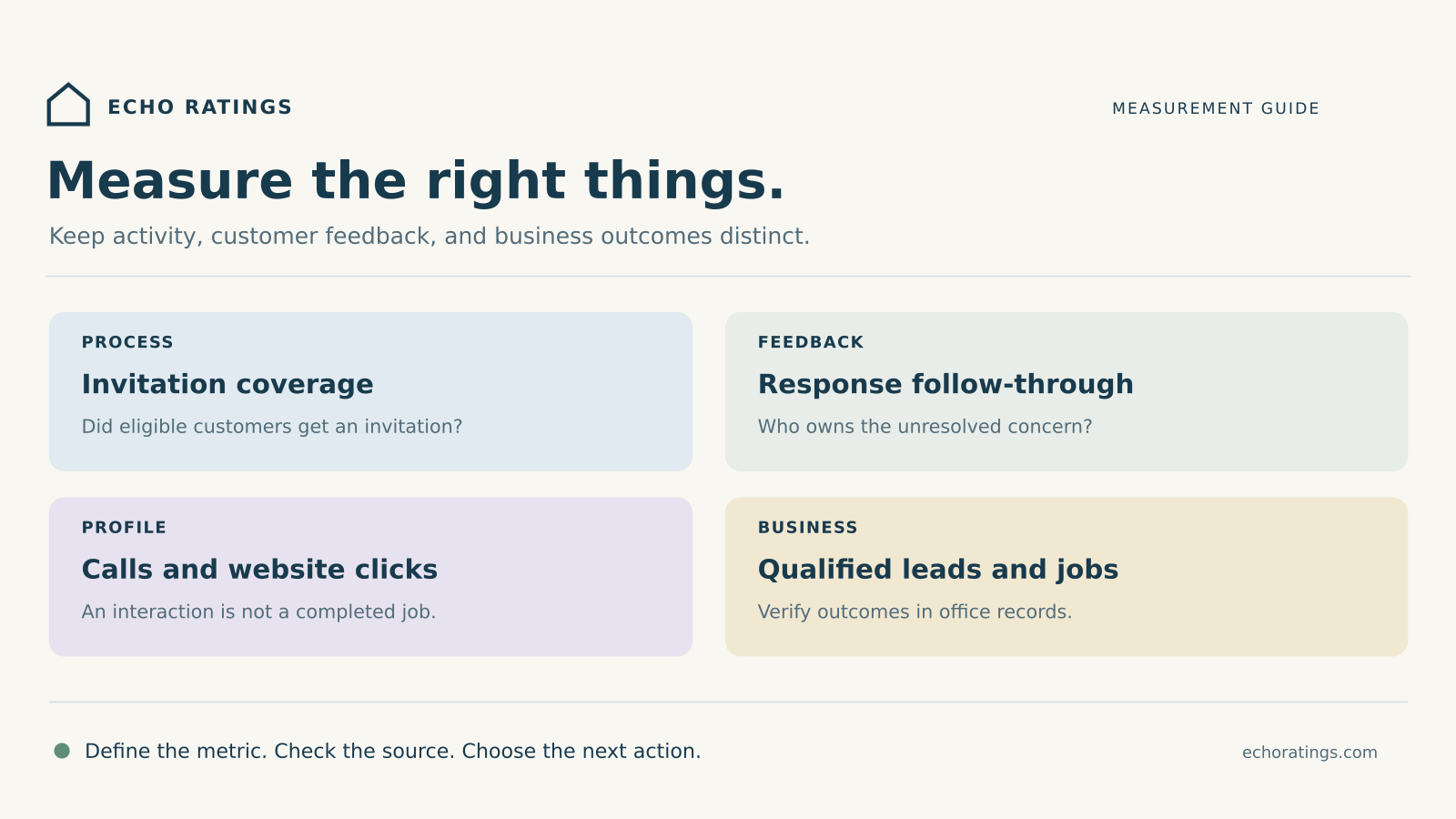
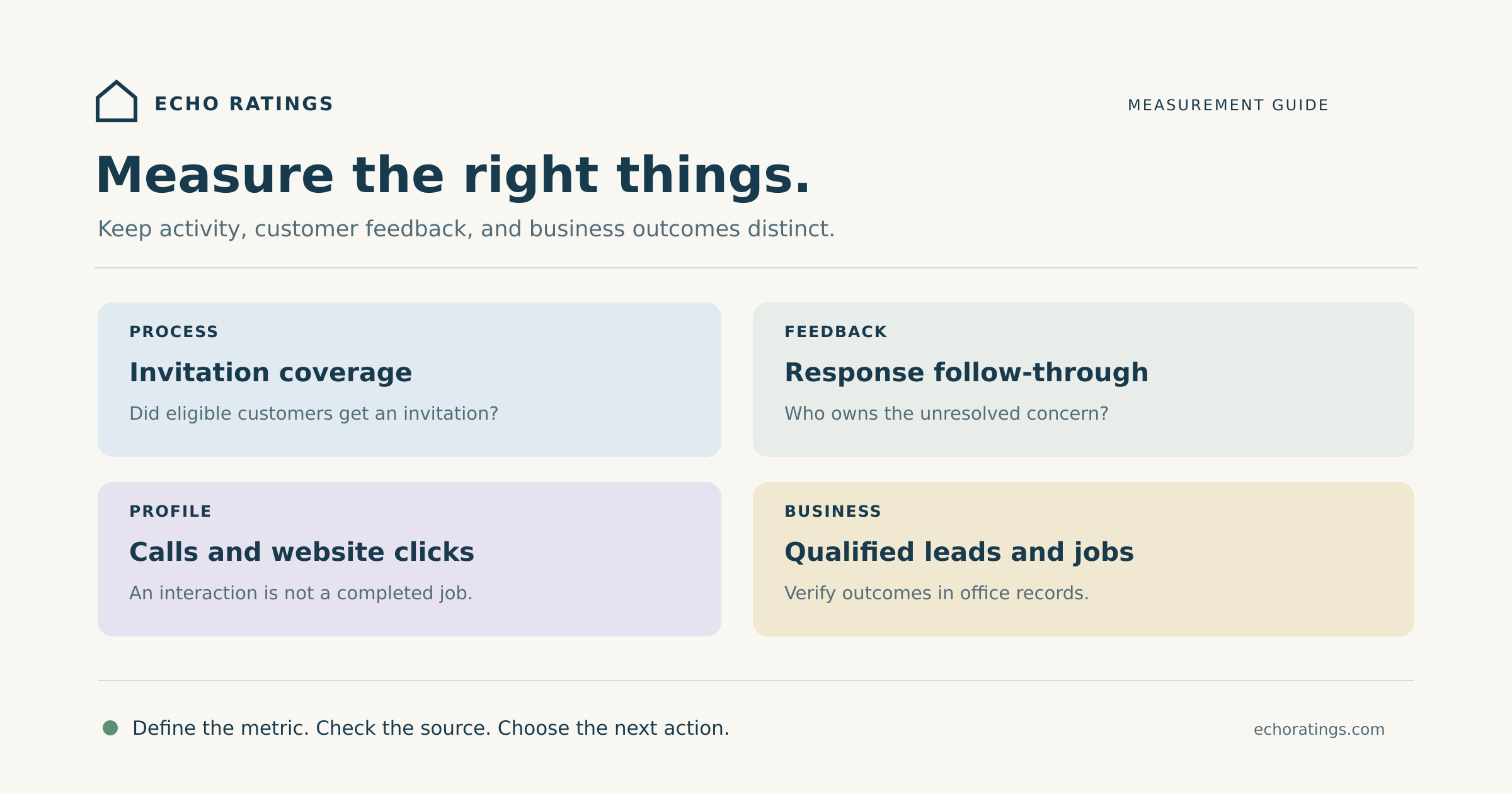
A useful review-management scorecard separates three layers: the work your office controls, the feedback customers publish, and the business outcomes you can verify. That separation gives an owner a practical next action instead of a bigger number to celebrate.
This guide focuses on operating the review process. For search visibility specifically, use the Google reviews and local SEO guide. For the overall request workflow, start with the home-service review framework.
Start with written definitions
Before building a report, agree on the unit being counted. A completed appointment, a unique customer, an invitation, and a published review are different records. One household can have several appointments and receive several messages while leaving only one public review.
Use a consistent reporting period and time zone. Record the serving branch and service type. Keep canceled work, duplicate records, test messages, and invalid contacts visible as separate exclusions rather than quietly removing them from the report.
Eligible customers
Count unique customers who meet your neutral service-completion and contact rules during the period. Write those rules down. Do not define eligibility by whether the customer seems happy. A recurring maintenance customer should not automatically become a new eligible person at every visit.
Customers invited
Count distinct eligible customers who received an invitation attempt, separately from the total number of messages. This lets the office distinguish broader coverage from repeated follow-ups. Record unsuccessful delivery when your messaging provider supplies that information.
Published reviews
Count the public reviews you can observe for the correct profile during the period. Keep this separate from invitation records. A review may arrive without a campaign, after a delay, or under a display name that does not match the job record.
Document the source and extraction date beside each number. If a system cannot supply a measure, mark it unavailable. An honest blank is more useful than a precise-looking estimate that no one can explain.
Use a small operational scorecard
Invitation coverage
Formula: unique eligible customers invited ÷ unique eligible customers × 100.
This measures whether the office follows its own invitation process. Check missing closeout statuses, branch routing, and contact records when coverage falls. Do not turn it into a staff quota for collecting reviews. Google’s Maps content policy prohibits selective positive solicitation, pressure, and requests for particular review content; it also lists staff review-solicitation quotas among prohibited practices.
Delivery problems and repeat-contact exceptions
Report failed deliveries, opt-outs, and customers contacted beyond your written frequency limit. Use a delivery rate only when the provider supplies a reliable delivered status, and identify whether the denominator is messages or people. Do not mix SMS delivery status with email opens or treat either as proof that the customer read the request.
A spike in repeat-contact exceptions should lead to a record-linkage or suppression check. The review automation guide explains where triggers and stop conditions belong.
Review response coverage and waiting time
Define the reviews that need a response, then count how many received one. Track the oldest unhandled review and a typical response time using the same start and end events each month. Specify whether the clock runs outside business hours.
These are internal management measures, not a Google-required response deadline. Read sample replies as well as the numbers. A fast generic reply may leave a service concern unresolved. Use the negative-review response guide for triage and private follow-up.
Feedback themes with an assigned owner
Group recurring comments into practical themes such as scheduling, punctuality, explanation, cleanliness, and follow-through. Record the underlying reviews and assign an action owner. A monthly count of comments about arrival windows is useful only if someone can improve the handoff.
New review activity and displayed rating
Keep both on the report, but avoid making either the only success measure. New public reviews divided by invitations in the same month is an activity ratio, not necessarily a customer conversion rate. The numerator can include uninvited customers and responses to older invitations. Label the limitation.
If you cannot match customers to public reviews reliably and appropriately, do not manufacture a matched conversion rate. Do not pressure customers to identify themselves publicly to improve your tracking. The review-gating guide explains why a cleaner dashboard never justifies biased invitation rules.
Keep profile interactions separate from leads and completed jobs
Google’s Business Profile performance guidance defines calls as clicks on the profile’s call button and website clicks as clicks on its website link. A call-button click is not proof of an answered conversation, qualified lead, or booked appointment.
Google also says profile performance can include organic results and Google Ads, and that available metrics vary by business. Use the same date range when comparing reports and label the source. Do not present the entire profile interaction total as traffic caused by your review campaign.
The office needs its own record of inquiries, qualified opportunities, bookings, completed work, and collected revenue. Define a qualified lead before comparing it across branches. Deduplicate a caller who later submits a form so one household does not become two new opportunities.
Use tagged website links for a defined purpose
Google’s campaign URL guidance explains how UTM parameters identify traffic sources in Analytics. For a business’s own website link on its profile, a consistent naming convention can distinguish that route from other visits.
An illustrative convention is utm_source=google, utm_medium=organic, utm_campaign=business_profile, and a non-personal branch label in utm_content. These are proposed labels, not mandatory Google values. Document them, preserve the intended landing page, and test that redirects keep the parameters.
Tagging a website link measures a website entry route. It does not show which review persuaded the visitor. Keep the direct Google review-request link used in customer invitations separate; the review-link guide covers that destination.
Validate the action before calling it a lead
Google’s key-event guidance explains that an important interaction must be measured by an event and marked as a key event. For an inquiry form, test a successful submission and a failed validation attempt. A click on Submit should not automatically count as a received inquiry.
Check for duplicate events and booking-provider handoffs with whoever maintains your site. Reconcile a small sample with actual office records before trusting the monthly total. A reported website event is still a different measure from a qualified or completed job.
Know what linked reports can and cannot show
Google offers Business Profile linking in Analytics for authorized accounts. Its documentation says metrics from multiple linked profiles are aggregated, cannot be segmented by an individual profile in those reports, and are available for the last six months. Keep branch-level records separately when needed. Linking reports does not create proof that reviews caused sales.
Make comparisons fair before drawing a conclusion
Compare periods with the same definitions and note changes in weather, service demand, advertising, staffing, hours, pricing, and available appointments. A heating company’s busy season is not a controlled experiment. A branch with a full schedule may turn away inquiries even while its reputation improves.
Read the measures together. If invitation coverage rises but deliveries fail, fix contact quality. If profile call clicks rise but qualified inquiries fall, inspect call handling and lead records. If responses are fast but the same complaint repeats, improve the underlying service process.
Hypothetical example: A plumbing office finds more published reviews after updating its closeout workflow. At the same time, it increases paid advertising and hires another dispatcher. The report can describe all three changes and the observed outcomes. It cannot honestly assign the entire revenue increase to reviews. This is an illustrative diagnostic scenario, not an Echo Ratings customer result.
Treat ROI as a higher-evidence calculation
A defensible review-program ROI calculation needs incremental profit attributable to the program and its full cost. A simple structure is: attributable incremental contribution profit, minus program cost, divided by program cost. Define the costs and accounting treatment with the person responsible for your finances.
The difficult part is attribution. Multiplying every profile interaction by an average job value does not establish incremental profit. If the evidence cannot isolate the program’s contribution, report costs, operational improvements, and observed business outcomes separately instead of claiming an ROI percentage.
The contractor software checklist can help you ask vendors what each report actually measures and whether the underlying records can be exported.
Protect customer information in measurement
Google’s Analytics privacy guidance prohibits sending personally identifiable information and highlights URLs, campaign parameters, and user-entered fields as possible sources of leakage. Keep customer names, email addresses, phone numbers, and home addresses out of analytics event labels and UTM values.
Store job-level reconciliation in an appropriately restricted operational system. Give the monthly report only the detail it needs. Check applicable privacy and consent requirements with your advisers; this guide provides general operational information, not legal advice.
Use one monthly review meeting
Have the office owner prepare definitions, the reporting period, the data sources, and a short explanation of exceptions. Pick one operational improvement and give it an owner and review date. For multiple branches, use the multi-location workflow to keep responsibilities clear.
Keep the scorecard understandable enough that a service manager can explain what changed without opening five dashboards. Good measurement should help the team make better decisions, not encourage more messages, selective requests, or unsupported sales claims.
Build a review process you can evaluate
Explore Echo Ratings for review workflows, compare pricing, or get a free reputation audit. You can also start a trial or talk with the team about your process. Use your own verified records to evaluate results. Official guidance was checked October 29, 2026.