Review gating can distort the story customers see
Review gating is a process that treats customers differently based on whether the business expects positive or negative feedback. A common version begins with a private survey: customers who choose a high score receive a public Google review link, while customers who choose a low score are sent to a private contact form or service-recovery queue instead.
That workflow may feel practical because it identifies unhappy customers quickly. The problem is not the private survey itself. The problem is using the answer to decide who gets a fair opportunity to leave a public review.
Google’s current prohibited and restricted content policy says merchants may not discourage negative reviews or selectively solicit positive reviews. It allows businesses to encourage content based on a genuine experience when they do not offer incentives or try to influence the rating or review content.
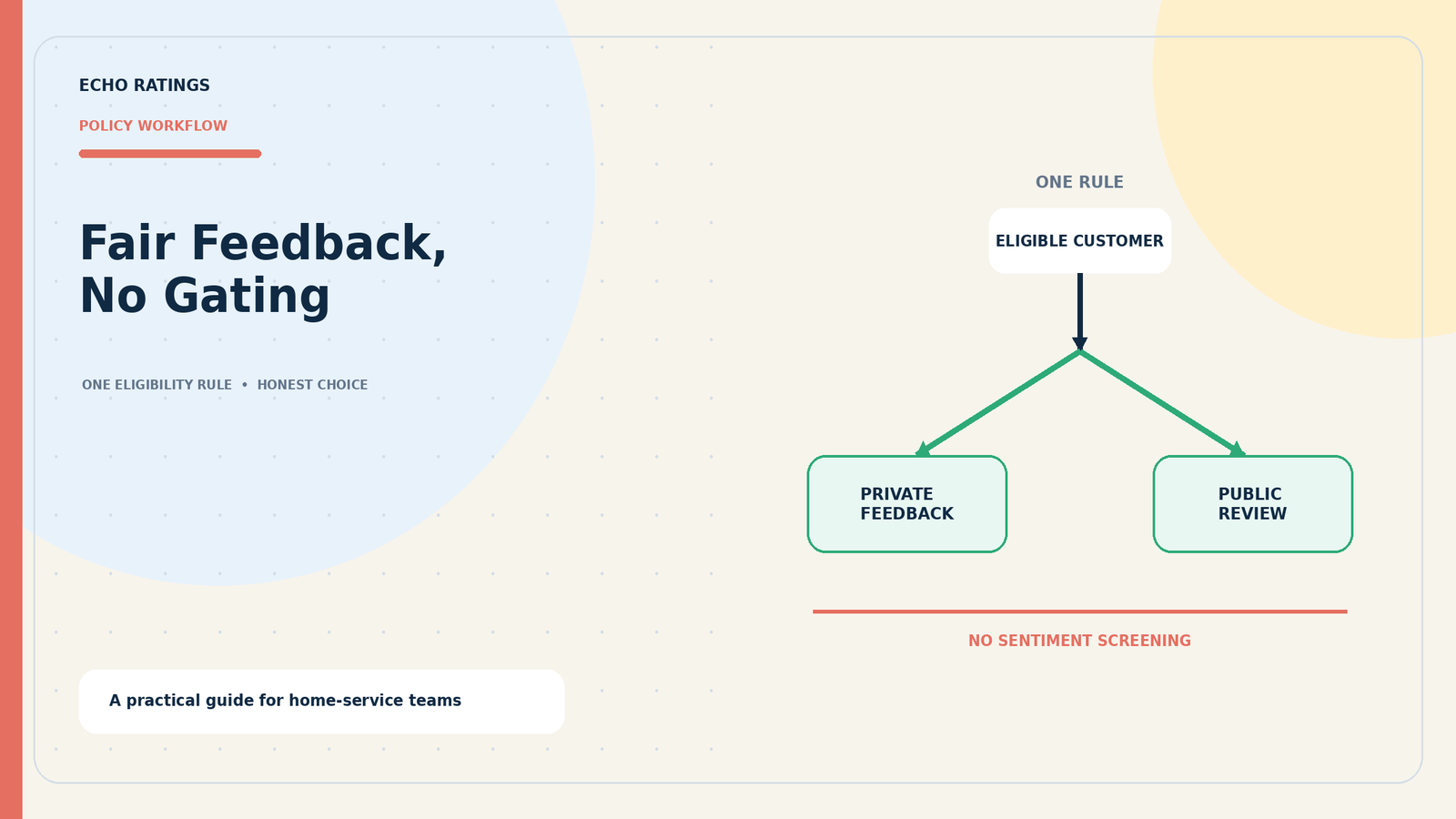
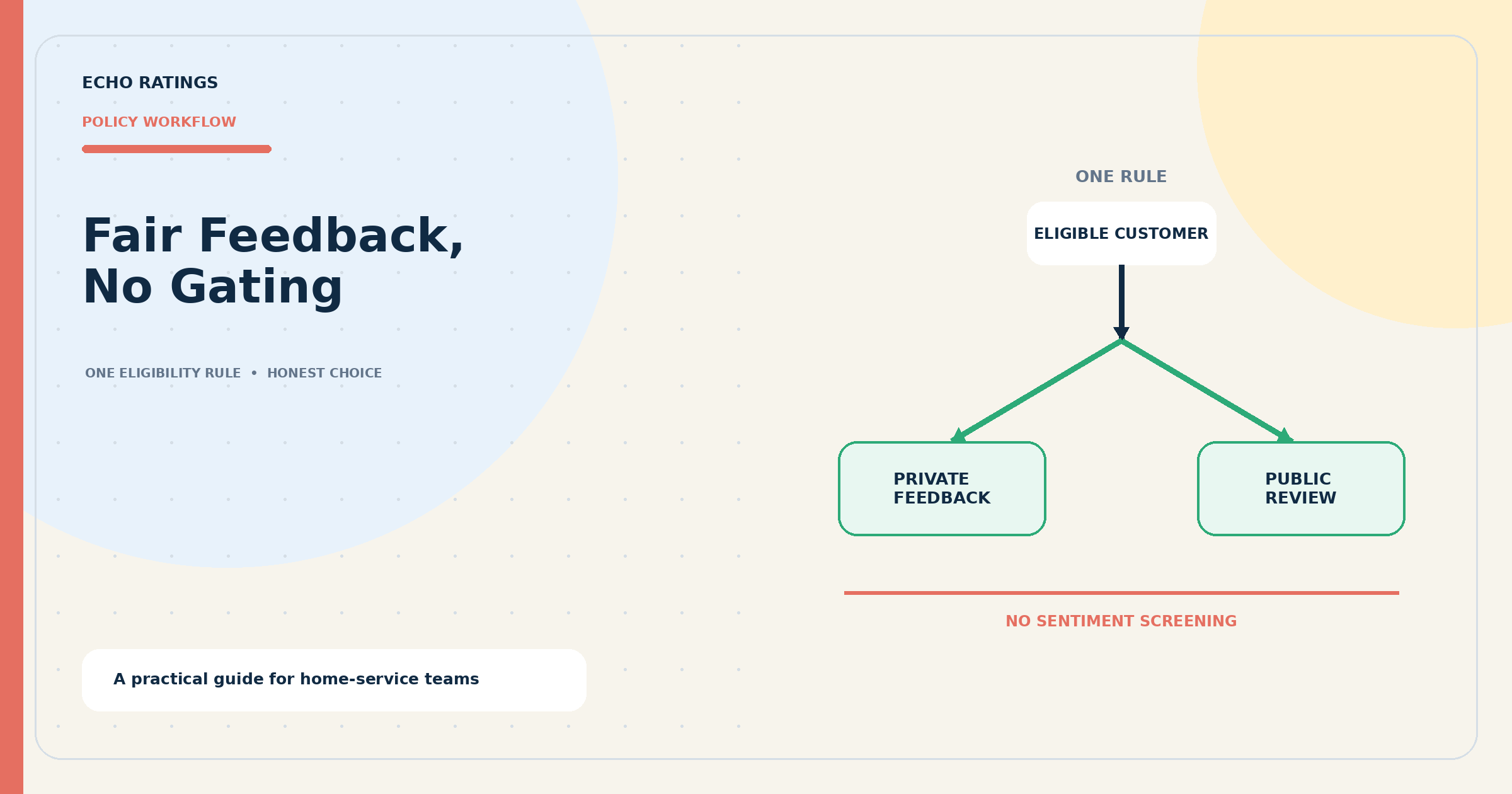
For a home-service company, the dividing line is straightforward: the same eligible customer group should receive the same neutral review invitation under the same rules. The invitation should not depend on a satisfaction score, technician prediction, complaint status, invoice amount, neighborhood, job type, or whether the customer praised the company during the visit.
What review gating looks like in everyday operations
Gating is not always built intentionally. It can emerge from informal instructions, software settings, or technician habits. Watch for patterns such as:
- Sending the Google link only after a customer selects “excellent” in a private survey.
- Asking technicians to request reviews only from customers who appear happy.
- Removing customers with open complaints from every public review campaign.
- Sending dissatisfied customers to support while hiding the public review option.
- Giving bonuses based on how many favorable reviews mention an employee.
- Using separate message templates that make positive feedback public and critical feedback private.
Review gating is different from responsible eligibility rules. A company may exclude duplicate contacts, people who did not receive service, test records, employees, vendors, or customers who have opted out of messages. It may also pause communications during a safety incident, active legal dispute, or sensitive service-recovery situation. Those rules should be based on relevance, privacy, consent, or risk—not predicted sentiment.
If you need a baseline process first, use our guide to getting more Google reviews for a home-service business and keep every request neutral.
Why selective review requests create policy and legal risk
Google prohibits selective positive solicitation
Google’s policy addresses the issue directly. Merchants may not discourage or prohibit negative reviews, selectively solicit positive reviews, offer incentives for reviews, or pressure customers to leave a rating while on the premises. Google also says reviews should reflect genuine, unbiased experiences.
That means a workflow can create risk even when no fake review is written. If the system routes only predicted promoters to Google, the business is attempting to shape the visible sample rather than inviting honest feedback from a consistent customer group.
The FTC analysis requires careful wording
The Federal Trade Commission’s Consumer Reviews and Testimonials Rule Q&A says the rule does not contain a specific prohibition on asking only customers a business thinks are happy. It also warns that the practice could violate the FTC Act. The same guidance explains that agencies and reputation-management companies can face liability for certain review suppression, fake-review, or sentiment-conditioned incentive practices.
The distinction matters. It is too broad to claim that every private feedback survey is automatically illegal. It is also unsafe to assume that a platform-compliant appearance eliminates legal risk. The facts, customer experience, disclosures, message design, and resulting overall impression can all matter.
The FTC guidance also separates generalized solicitations from deceptive conduct. Asking a defined customer population to share an honest experience is different from purchasing false reviews, conditioning compensation on a particular sentiment, threatening reviewers, or misrepresenting how feedback is collected and displayed.
This article provides general operational information, not legal advice. Obtain qualified counsel for questions about the FTC Act, state law, contracts, regulated services, litigation, or a specific campaign.
Private feedback and public reviews can coexist
A compliant workflow does not have to choose between service recovery and public feedback. Every eligible customer can receive two clearly labeled options in the same message:
- Share private feedback with the company so a manager can investigate or improve the service.
- Leave an honest public review through the applicable platform link.
Keep both choices available regardless of the customer’s rating or written comments. Do not hide, disable, delay, or visually minimize the public option after a critical response. A private form should not say or imply that criticism must remain private.
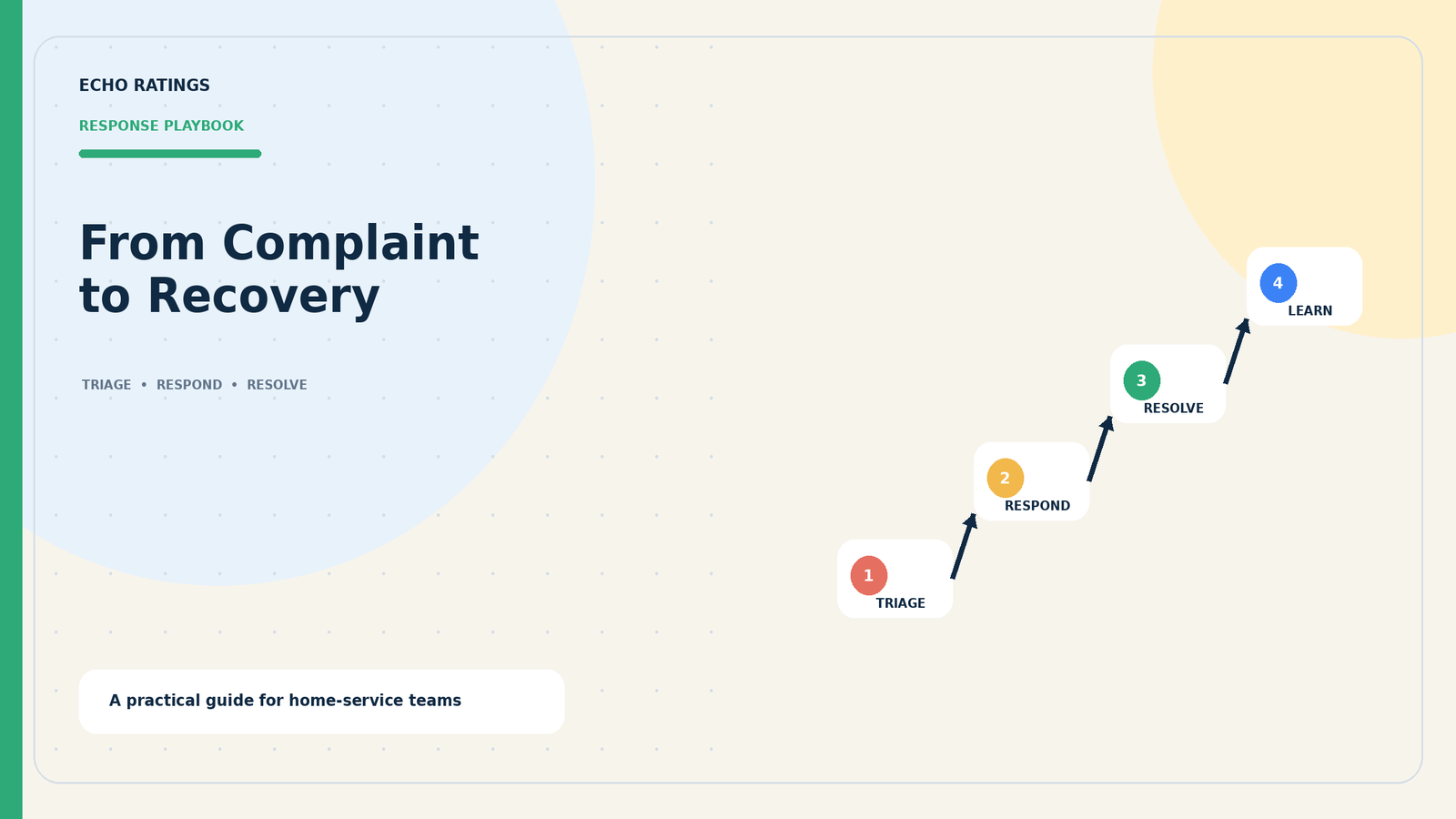
When a customer reports a real problem, start service recovery promptly without bargaining over the review. Our negative-review response guide covers triage, privacy, escalation, and credible follow-through.
Build a fair review request workflow
1. Define an objective eligibility event
Choose a service milestone that does not depend on sentiment. Examples include a completed repair, paid invoice, closed installation, finished maintenance visit, or confirmed warranty appointment. Document the exact event for each job type.
2. Apply the rule consistently
Send the same neutral invitation to every customer who meets the rule, subject to documented exclusions for consent, duplicates, invalid contact data, non-customer records, or genuine safety and legal concerns. Do not let technicians manually choose recipients based on mood or predicted rating.
3. Use neutral language
Ask customers to share an honest experience. Avoid language that requests a particular star rating, suggests only happy customers should respond, or tells customers what to mention. The Echo Ratings review request templates provide policy-conscious examples for service businesses.
4. Offer the same destination
Use one verified review link or QR code for the applicable location. Do not swap the destination after a customer answers a satisfaction question. Follow our Google review link and QR-code guide to create and test the correct route.
5. Separate recovery from review collection
Route complaints to a real owner with a deadline, but leave the review invitation unchanged. The support task should exist because the customer needs help—not because the company wants a review removed, revised, or withheld.
6. Set neutral reminder rules
Reminders should depend on time and delivery state, not whether the customer expressed satisfaction. Stop when the customer responds, opts out, reaches the reminder limit, or enters a documented high-risk escalation. Our post-service review automation guide explains timing, handoffs, and stop conditions.
7. Monitor locations and employees without quotas
Measure delivery, response, review volume, unresolved complaints, and workflow consistency. Avoid staff quotas that pressure employees or customers to produce favorable reviews. Investigate unusual spikes, repeated wording, or requests tied to a specific rating.
8. Preserve an audit trail
Record why each contact was included, excluded, paused, or stopped. Keep the campaign version, destination link, send time, consent source, delivery result, and follow-up history. A clear audit trail helps managers find inconsistent routing before it becomes a larger problem.
A practical home-service example
An HVAC company closes 80 eligible service calls in one week. Its system removes duplicates, invalid mobile numbers, opted-out contacts, internal test jobs, and customers who never received service. Every remaining customer receives the same message after the job closes: “Thank you for choosing us. Would you share an honest review of your service experience?”
A customer who reports a no-cooling callback is assigned to the service manager immediately. The company does not ask that customer to change or remove a review, and it does not condition help on public feedback. The review invitation and the recovery process remain separate.
Audit your current workflow for hidden gating
Review the full customer journey, not only the final text message. A campaign that looks neutral at the last step may still be gated earlier by a satisfaction branch, technician choice, CRM filter, or manual suppression list.
- Map every trigger, branch, delay, exclusion, destination, and stop rule.
- Identify every field related to satisfaction, complaint status, predicted rating, or customer sentiment.
- Confirm those fields do not control access to a public review link.
- Compare recipients with completed jobs to find locations or employees sending selectively.
- Open every link on mobile and desktop and verify the correct business location.
- Review message language for requested ratings, pressured timing, or suggested content.
- Check that private feedback remains available without replacing the public-review option.
- Document approved exceptions and require manager review for changes.
If manual spreadsheets make this difficult, explore Echo Ratings to centralize request, monitoring, and response workflows, then review pricing for the right operating fit.
Frequently asked questions
Is every customer satisfaction survey review gating?
No. A private survey can be useful for service recovery and operations. It becomes problematic when the response determines whether the customer receives, sees, or can easily use the public review invitation.
Can we ask only customers who completed a job?
Yes, an objective completed-service rule is different from predicting sentiment. Define the rule consistently and exclude non-customers, cancellations without service, duplicates, invalid contacts, and opted-out recipients for operational reasons.
Can we pause messages during a serious complaint?
A narrowly documented pause for safety, privacy, legal, or insurance handling can be an operational safeguard. It should not become a blanket method for suppressing critical customers. Have counsel review high-risk policies when needed.
Can technicians decide when to ask?
That creates inconsistency and can become selective solicitation. A system-triggered request based on a documented service event is easier to manage, audit, and apply fairly.
Can we ask for an honest review and private feedback in one message?
Yes. Keep both choices clear and available to every eligible customer. Do not change the public option based on the private response.
What should we do if our current software uses a positive-score branch?
Disable the sentiment-based branch, preserve the service-recovery route, and send the same neutral public-review option to the defined eligible population. Then test the workflow with low, middle, and high survey responses.
Build a review program customers can trust
The safest long-term approach is also the simplest to explain: ask a consistent group of real customers for honest feedback, give criticism a genuine recovery path, and never make public access depend on predicted sentiment. That produces more credible feedback and clearer operating data.
Start with a free Echo Ratings reputation audit. When you are ready to build a consistent workflow, start a 14-day trial or book a walkthrough.