
How Reviews, Trust and Real-World Proof Shape Customer Choice for Today’s Small Businesses
In the digital era, customers rarely make decisions based on features or pricing alone. They choose businesses they feel they can trust, and the first place they go to decide whether you are trustworthy is your reputation. Before a prospect clicks “Call,” “Book,” or “Visit Website,” they evaluate how other customers describe their experience and how you respond when someone takes the time to leave feedback. Reputation has shifted from being a background signal to becoming the centerpiece of purchasing decisions, especially for service-driven industries such as healthcare practices, real-estate firms, legal advisors, home services, wellness studios and any business where credibility and experience matter.
Research reinforces what most business owners feel intuitively. Ipsos reported that 87 percent of global consumers factor a company’s reputation into their purchasing decisions. Capital One Shopping’s analysis shows that 93 percent of American consumers say online reviews influence what they buy. These numbers are not abstract; they reflect the modern buyer’s desire for reassurance. People want to know they’re dealing with professionals. They want to avoid risk. They want to feel safe choosing you. That emotional safety is what reputation provides.
EchoRatings was built with this shift in mind. Instead of treating reputation as something passive that “happens to you,” EchoRatings helps business owners take control of how they are perceived online by boosting review volume, simplifying responses, and presenting a clear, consistent story across the platforms that influence customer behavior.
1. The Shift in Buying Behavior: Customers Don’t Buy Products, They Buy Trust
Years ago, businesses could differentiate themselves by listing features or prices. But today, those elements hardly matter when a buyer sees a competitor with dozens of strong reviews and a track record of responsiveness. Customers assume that if you are attentive in your reviews, you will be attentive in your service. When you respond quickly, they believe you take accountability seriously. When they see recent reviews describing real experiences, they feel confident reaching out. Trust has replaced features as the deciding factor.
For a small business, this shift means ignoring reputation is the equivalent of competing with one hand tied behind your back. If your competitor has 30 recent reviews with thoughtful replies and you have three older reviews with no engagement, the buyer is statistically and emotionally predisposed to choose them. EchoRatings makes it easier to fix that imbalance by helping businesses increase review flow and respond consistently, even when schedules are packed.
2. What Reputation Really Means in a Digital Context
Reputation is not simply a star rating. It’s the sum of everything a customer encounters about your business across platforms and touchpoints. It includes the number of reviews you have, the recency of those reviews, the tone of the comments, and how you respond to them. It also includes your social proof, testimonials, case studies, and even how you show up publicly when customers need support.
In practical terms, reputation answers a simple question for every potential buyer:
“Do these people follow through on what they promise?”
When a customer sees a strong volume of reviews, thoughtful replies, and consistent visibility, they feel more comfortable choosing you. EchoRatings supports this full picture of reputation by helping small businesses stay active across platforms that matter most, Google, Yelp, Facebook and industry-specific directories, while keeping tone and communication authentic.
3. Hard Numbers: How Reviews Directly Influence Conversions
The data surrounding review behavior provides a clear explanation for why reputation drives so many buying decisions. The Spiegel Research Center found that a product with just five reviews has a 270 percent higher likelihood of being purchased compared with a product with no reviews. For higher-priced services, the lift increases to 380 percent, showing how deeply reviews matter when the stakes are higher. Capital One Shopping’s analysis also confirms that the first few reviews are the most influential, meaning buyers rely heavily on early social proof as a validation signal.
The quality of reviews matters just as much as the quantity. Emplifi’s survey of more than 2,000 consumers across the U.S. and U.K. found that 87 percent of buyers trust customer reviews and ratings more than influencer or celebrity endorsements. This is because reviews feel real, unpolished, and grounded in shared experience. When combined with consistent responses from the business, reviews create a feedback loop of trust.
EchoRatings positions small businesses to leverage these numbers by helping them grow review volume while maintaining a consistent, human voice in every response. This strengthens the signals that influence customer decisions long before a sales conversation begins.
4. Why We Use the “70 Percent” Benchmark
Some studies report 87 percent, others 93 percent, and others 79 percent. When you synthesize these across industries, decision stages and regions, you arrive at a reasonable conclusion: roughly 6 to 7 out of every 10 buying decisions rely heavily on reputation signals. This does not mean reputation is the only factor, but it is often the factor that tilts the decision toward a yes or nudges a prospect toward your competitor.
For small businesses, this has direct implications. If ten potential customers find you online, at least six are asking themselves, “Can I trust this business to deliver?” If you do not have the reviews, responses or social proof to answer that question confidently, you’re losing those leads before you ever get a chance to speak with them. EchoRatings helps close that gap by ensuring you show up with the signals customers expect: consistent reviews, active responses, and a clear demonstration of reliability.
5. Common Reputation Traps for Small Businesses
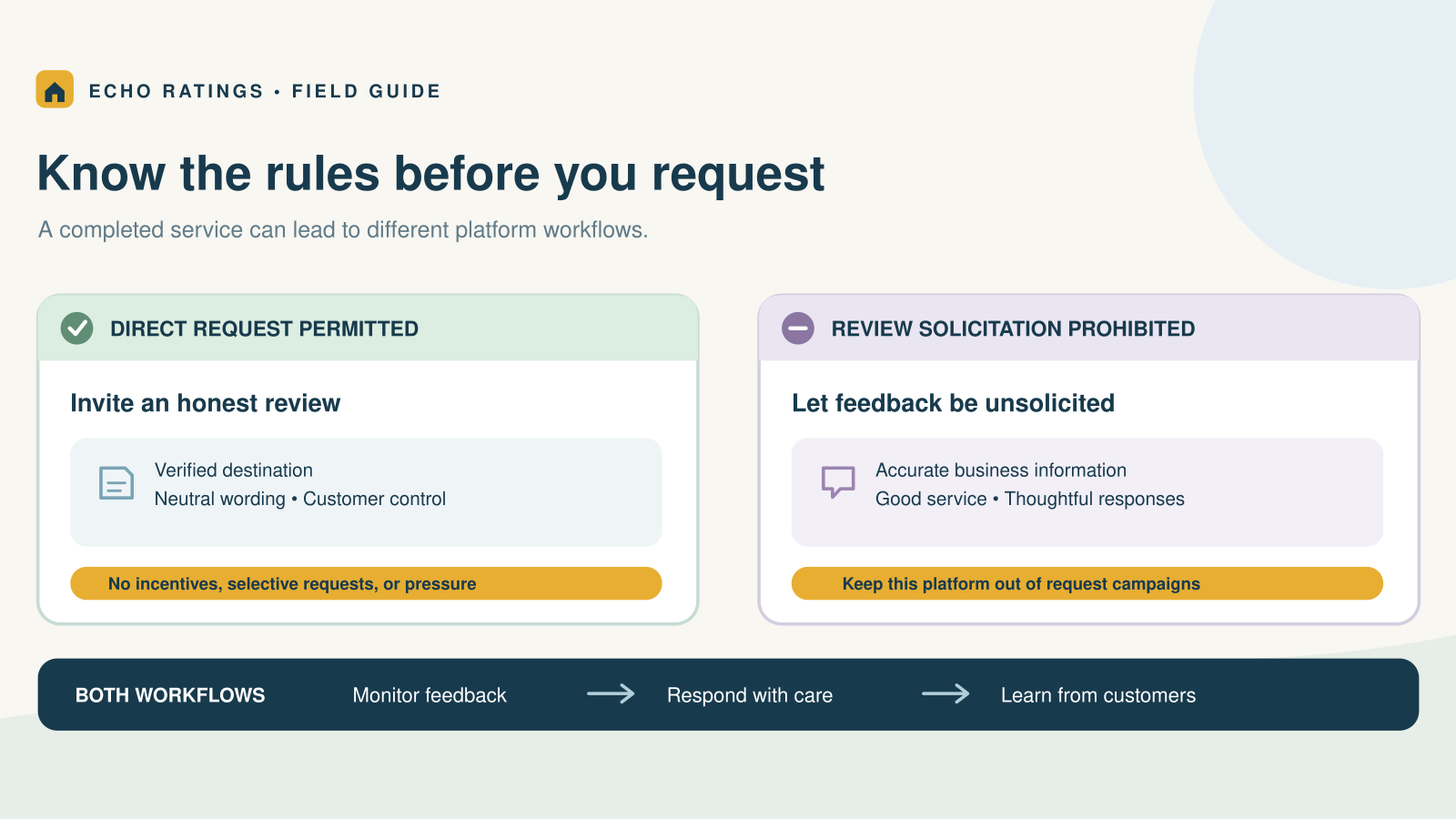
Many SMBs unintentionally limit their growth by falling into familiar reputation traps. One of the most common is having a low review volume or large gaps between reviews. Even if your rating is high, a small number of outdated reviews can make your business appear inactive or untested. Another trap is failing to respond to reviews, which makes the business look disengaged. Capital One Shopping found that 89 percent of consumers are more likely to choose a business that responds to reviews compared to one that does not. Buyers want to see that you care enough to acknowledge feedback.
Another issue is aiming for a perfect five-star rating. Research from Spiegel shows that near-perfect scores can actually lower conversion because they feel unrealistic. Finally, many SMBs treat reputation as a campaign rather than a continuous practice. They push for reviews for a week or two, then stop. Reputation is built gradually through every customer interaction, and consistency is what strengthens it over time. EchoRatings helps keep that consistency alive by automating review requests and streamlining responses so businesses don’t fall into these traps.
6. Turning Reputation Into Conversion: A Practical Framework
Improving reputation begins with understanding where you currently stand. This means reviewing your platforms to see how many reviews you have, how recent they are, what customers are saying and how often you reply. Once you know your baseline, you can set reasonable targets. A helpful benchmark for small businesses is aiming for at least twenty reviews within ninety days with an average rating above 4.4. Maintaining a steady flow of two to three reviews per week strengthens both customer trust and SEO performance.
From there, the next step is creating a reliable review process. Instead of asking customers manually or inconsistently, business owners should automate review requests after positive interactions. A personalized, timely request is far more effective than a broad, delayed ask. Responding to every review matters just as much; it shows attentiveness, reinforces trust, and signals that feedback is welcomed. EchoRatings makes these steps easier by generating review requests automatically and drafting thoughtful replies in your tone, allowing you to maintain a personal touch without increasing your workload.
Once reviews start coming in, use them as part of your marketing ecosystem. Share standout reviews on social media, highlight success stories on your website, include customer quotes in proposals and create simple narratives that show how your reputation is improving. Transparency communicates confidence and builds trust, especially for prospects comparing you to competitors.
7. Real-World Example: Why Reputation Decides the First Call
Imagine you’re a dentist, a legal consultant, a property manager or a home-services provider. A potential client searches for your service and finds your Google Business Profile, which shows three reviews, a rating of 3.8 stars and no new activity for eight months. Without consciously realizing it, the customer feels uncertainty. They wonder whether your business is still active and whether they can rely on you.
Now imagine your competitor has twenty-eight reviews, an average rating of 4.5 stars and recent replies to every customer. The difference is immediate. The competitor appears engaged, experienced and dependable. They become the default choice before the customer even thinks about comparing prices or availability. This gap in reputation is easy to overlook internally, but it has substantial consequences externally.
EchoRatings helps business owners build the credibility required to win these moments. By improving review flow and ensuring every review receives a warm, human reply, you reshape how prospects perceive you, often before any direct interaction.
8. Why SMBs Can Win Big with Reputation and How EchoRatings Lowers the Barriers
Big companies have resources, but small businesses have proximity. You interact directly with your customers, often know them by name and can make reputation management feel personal rather than scripted. Your review requests feel authentic, not corporate. Your responses carry your voice, not a template. And because so many SMBs ignore reputation or struggle to keep up, being consistent here gives you disproportionate advantage.
The challenge has always been bandwidth. EchoRatings removes that barrier by giving you a simple way to ask for reviews, draft replies and maintain a steady, credible online presence without adding administrative burden. Reputation becomes something you manage naturally rather than something you dread.
9. Conclusion: Reputation Isn’t Optional. It’s Your Growth Engine.
If 70 percent of buying decisions rely on reputation signals, then managing those signals is not optional. It’s foundational. When you treat reputation as an active part of your business , something you measure, improve and showcase — you become the trusted choice, not just another option. This trust makes sales easier, reduces price objections, increases referrals and strengthens loyalty.
Your reputation is not just a reflection of how good you are. It’s how clearly the world can see it. EchoRatings exists to make that visibility easier, more consistent and more authentic so your work speaks for itself and your customers amplify that message for you.